Almost 70% of the world's oil is
used as transportation fuel: cars, trucks, ships, planes.
The key to protecting the environment and disconnecting ourselves
from fossil fuels is to find a new mobile energy source.
To inform everyone on past and latest developments in fuel efficient
technology and legislation
Back when gas was only over $3/gal
it was expected to reach $4/gal by
summer 2008. It did.
The price of gasoline is now
expected to be over $7/gal
before next summer and
"$10-12 within a few years"
What will you be driving then?!
What will the trucks, ships, & planes
that deliver goods and services be using
for fuel - that we all end up
paying for?!
"World oil consumption continues to grow despite 7 consecutive years of rising
prices. Preliminary data indicate that world oil consumption during the first
half of 2008 rose by roughly 520,000 bbl/d compared with year-earlier levels.
Compared to year-ago levels, this increase reflects a 170,000-bbl/d gain in the
first quarter, followed by an 870,000-bbl/d increase in the second quarter. A
760,000-bbl/d decline in consumption in OECD countries during the first half of
2008, mainly concentrated in the United States, was more than offset by a
1.3-million-bbl/d increase in consumption in non-OECD nations led by China and the
Middle East." [Therefore, despite EIA claims of flat gasoline prices at
around $4.15/gal for now through 2010, the price of gasoline, diesel, natural
gas, and therefore food, clothing, plane fares, etc., etc. will continue to go up
(and companies will coninue to fold, putting more people out of work!) ... unless we
and the other "OECD" countries cut our consumption by more than double or
triple the current rate, knowing the "non-OECD" are already "ramping up" to incerase
their demand even more than the current accelerating rate.] McCain's dream of
more drilling to produce more oil 5 to 10 years from now is a nightmare! It will be
too little too late. Poor countries will have riots in the streets and economies
will have divided further into the extreem rich and the extreem poor.
Oil went over $100/barrel(bbl) for the first time on Jan. 2nd 2008
Oil went over $129/barrel(bbl) for the first time on May 19th 2008
Oil went over $139/barrel(bbl) for the first time on June 6th 2008
Oil went over $147/barrel(bbl) for the first time on July 11th 2008
World oil production has peaked. Period. All 3 of the worlds largest oil
fields are in decline, along with many others! No amout of drilling in
Alaska, the Gulf Coast, the Artic, etc. etc. will compensate. Adding that China
and India are ramping up their consumption, 35 even 45 mpg CAFE standards won't be
enough. Electric motors (with only one moving part, by the way) is the only
rational answer.
Electrical outlets are already everywhere. No need to spend $billions for
"hydrogen stations" Put a solar panel on your roof and recharge every night for
free!
$6 or $7 by next summer? What if it is "only" $5/gal.? At less than $4/gal
businesses are already closing, airlines are cutting back, others have stopped
hiring, the average family won't travel on vacations as far as they used to - they
won't even travel about town as much as they used to!
Only the very rich have gotten richer, all the rest of us have gotten poorer. The
rich, politicians, (especially Bush and Cheney) may think high oil prices are good
for their oil friends and, it will be if we only start averaging 35+ mpg in our
vehicles. Prices won't drop, just rise a little slower. Only if we
"cut the chord" and go electric, will we recover... from this un-democratic,
"royal" sell-out by politicians to the coorporate giants.
another chart from another source:
(monthly - 8 years)
"Who is to blame for high gas prices?"
heavy, gas-guzzling SUV's were getting a BIG tax break:
As part of Bush's "Oil" Administration, "Bush's Energy Secretary,
Spencer Abraham, led the administration's effort to scuttle
fuel-economy standards, allow SUVs to escape fuel-efficiency
minimums and create obscene tax incentives for Americans to buy
the largest gas guzzlers."
(Americans are not so demanding of some right to drive big vehicles
as they have
been manipulated, succored, by the current "oil" administration, into
buying them.)
Oil refineries were making operating profits in the
$1/gallon
range in May 2007.
NY Times, JAD MOUAWAD, May 14, 2008
Some consumer advocates say they are deeply suspicious about the behavior
of refiners who are sharply cutting production at a time of record gasoline
prices.
Bush has turned down repeated requests by consumer groups for the
Federal Trade Commission to investigate price gouging by oil and gas
companies, despite a March 2001 FTC finding that companies hoarded
gasoline to drive up prices and boost profits, costing consumers
billions of dollars.
CRIMES AGAINST NATURE by ROBERT F. KENNEDY, JR., page 35
"Gasoline sprayed into the combustion chamber is not vaporized. It is a liquid,
mist, in suspension resulting in a tremendous loss of potential, unreleased,
energy. Secondly, only about 15% to 20% of the energy that is released
by burning fuel in an internal-combustion engine
does any work.
Most of the rest is given off as heat."
68% of the world's oil is used as transportation fuel
(EIA)
despite the fact that it could be something like
1 or .5%. (see above paragraph and vaporizing carburetors below
or inventor Raphial Morgado)
Worse, many evolutinary and even revolutinary inventions have
occurred only to be
deliberately ignored or (euphamistically) "silenced".
See the page
Future Past.
the
Fish
Carb. & more:
They worked:
the Ogle,
the Pogue,
and many others: You may remember, years ago, hearing
of people who developed very efficient (vaporizing) carburetors
that got 100 mpg or 200 mpg or more with the big V8 engines
of their day. There were many news reports and
popular magazine articles covering
numerous "super" carburetors !
It is now known that California's energy crisis was largely
engineered by Enron. After one meeting with Enron CEO Kenneth Lay, Cheney
dismissed California Gov. Gray Davis' request to cap the state's energy prices.
That denial would enrich Enron and nearly bankrupt California. According to the
New York Times, Cheney's energy task-force staff circulated a memo that
suggested "utilizing" the crisis to justify expanded oil and gas drilling.
President Bush and others would cite the engineered California crisis to call
for drilling in the Arctic National Wildlife Refuge.
more
There is no scientific debate in which the White House has cooked the books
more than that of global warming. In the past two years the Bush administration
has altered, suppressed or attempted to discredit close to a dozen major
reports on the subject. These include a ten-year peer-reviewed study by the
International Panel on Climate Change, commissioned by the president's father
in 1993 in his own efforts to dodge what was already a virtual scientific
consensus blaming industrial emissions for global warming.
After disavowing the Kyoto Protocol, the Bush administration commissioned the
federal government's National Academy of Sciences to find holes in the IPCC
analysis. But this ploy backfired. The NAS not only confirmed the existence of
global warming and its connection to industrial greenhouse gases, it also
predicted that the effects of climate change would be worse than previously
believed, estimating that global temperatures will rise between 2.5 and 10.4
degrees by 2100.
A May 2002 report by scientists from the EPA, NASA and the National Oceanic and
Atmospheric Administration, approved by Bush appointees at the Council on
Environmental Quality and submitted to the United Nations by the U.S.,
predicted similarly catastrophic impacts. When confronted with the findings,
Bush dismissed it with his smirking condemnation: "I've read the report put out
by the bureaucracy. . . ."
The Bush administration now plans to contract out thousands of
environmental-science jobs to compliant industry consultants already in the
habit of massaging data to support corporate profit-taking, effectively making
federal science an arm of Karl Rove's political machine. The very ideologues
who derided Bill Clinton as a liar have institutionalized dishonesty and made
it the reigning culture of America's federal agencies.
from the inside:
Jeremy Symons, who represented the Environmental Protection
Agency on Vice President Cheney's energy task force, described
the Bush administration's "carefully orchestrated policy of delay":
"It's a charade... They have a single-minded determination to
do nothing -- while making it look like they are doing something."
Listen to how one man was told there is an international
agreement denying him the right to produce, or patent his
invention. He does not know he was lied to but, we know
that, given that lie, no one in power was going to help
him and they had the power and the corruption to stop him
if he so much as tried on his own:
Daniel Dingel
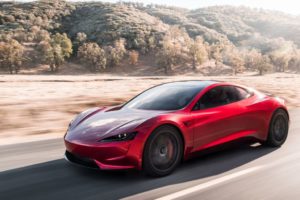
The Tesla Roadster, a 100% electric vehicle, has a 200 to 250
mile range, weighs about 2500 lbs, and goes 0 to 60 in 4 seconds.
August 8 2007: LOS ANGELES (Reuters)
The Silicon Valley-based Tesla has pre-sold 570 cars to the likes
of California Gov. Arnold Schwarzenegger, for his wife Maria
Shriver, and to actor George Clooney.
February 22 2008
The company will make 1,800 2008 model year cars.
"The torque
(acceleration) is unbelievable! And eerie. The power just
comes on right now and does not abate. It's absolutely batty;
unlike anything we've experienced. We think our kidneys may still
be embedded in the seatback. And it sticks."
"The Tesla electric car's really been the only plug-in sled
we've so far been able to love."
learn more
Visit our
news page
page to read about this 50 mpg TDI biodiesel built
by 5 kids at West Philly. H. S.
"0 to 60 in 4 seconds on soy bean oil" It's a hybrid too!
progress reports 40 mi on a charge then 50 mpg after that. $35,000
[Chevy Volt hybrid] to be a running prototype in June 2008
It is a begrudging 1st step forward from Detroit which fought any
improvement in gasoline consumption ratings for as long as possible
The high sales numbers they are sure to get should teach them a lesson.
(there is already a waiting list of 20,000 potential buyers)
50 mpg will look like a guzzler when the Volvo (below) comes out.
with a small electric motor in each wheel.
Charging time: 3 hrs.
To be available in 2015
Thursday, 24 May 2007
Europe may restrict oil exports to the US.
see article
3-01-2007
Legendary Texas oilman Pickens says global oil production
at its peak
see article
3-11-2006
Princeton University emeritus professor and renowned oil analyst
Ken Deffeyes thinks that the all-time production peak for
petroleum, or "peak oil," will occur on or around this Thanksgiving.
see article
The Real Oil Shock
The Saudis won't be able to meet demand.
The likelihood that Saudi Arabia can increase its output to even
15 million bbl. a day is remote. The bottom line: the global oil
supply has probably peaked.
From the
Sep. 26, 2005 issue of TIME magazine
- by the author of
Twilight in the Desert: The Coming Saudi Oil Shock and
the World Economy
see article
May 28th, 2007
Peak Oil Has Arrived
The 3 Largest Oil Fields in the world have peaked!
The #1 Saudi Aramco Ghawar field: Saudi fields overall are in decline at 2% to
8% a year and, already, they are injecting 7 million barrels a day of seawater in order
to produce only about 4 to 5 million barrels per day. What comes out is 55% seawater.
The original oil column was 1300 feet thick. Today, it is less than 150 feet thick. One
must draw the necessary conclusions that most of the oil has been removed from Ghawar.
#2. Burgan, Kuwait - in decline It is incredible revelation that the second largest oil field in the world is
exhausted and past its peak output. Yet that is what the Kuwait Oil Company revealed
about its Burgan field.
#3. Cantarell, Mexico - in decline Cantarell has actually begun to decline. The most recent Upstream (May 11,
2007) quotes Jesus Reyes Heroles, the Pemex leader as saying that Cantarell would
produce only 1.5 million barrels per day in 2007. This is compared with over 2 million
in 2004.
see article footnote: "investors are also increasingly concerned about falling oil production
in Russia and Mexico, which are major oil producers" - JOHN WILEN, AP Business Writer,
May 6, 2008
May 28th, 2007:
It is important to know that America has two largely unconnected oil worlds - the five west coast states (California, Oregon, Washington, Nevada, and Arizona) and the rest of the country. The West Coast gets its imported gasoline supplies by tanker across the Pacific. The rest of the country gets its imports from tankers across the Atlantic." In summary, US gasoline stocks are low, the refineries are stretched and imports are minimal.
January 30, 2007 6:03
Bush's Stealth Tactics to Combat Congress
Lest you think President Bush is hamstrung by a recalcitrant Congress, think again.
The NYT reports that the White House recently signed a directive giving it "greater
control over the rules and policy statements that the government develops to protect
public health, safety, the environment, civil rights and privacy." The directive
effectively places a Bush gatekeeper in areas of key domestic policy such as the
Environmental Protection Agency and the Occupational Health and Safety Administration.
. . .
Bush's "Don't do anything about the environment if it impeads business, if it
costs money" is the same attitude the Chinese have right now. Bush is sending
us in their direction:
the World Bank estimates that 16 of the world's 20 most
polluted cities are found in China's industrial areas.
(Pittsburgh recently wrested the title of America's most polluted city from Los Angeles)
2005: "By the end of 2006 there will be no unused production capacity."
Oil depletion and the economy
The global economy has linked its fate to oil to such a degree that in
the event of supply disruptions, sharp oil price rises would ensure a
severe economic recession. Although efficiency gains and the economic
trend from manufacturing towards service industries have resulted in a
significantly lower oil consumption per unit of Gross Domestic Product
(GDP), a hard landing would spell the end of globalisation and
consumerism, leaving us to obtain most necessities from within our
locality. Economic fallout coupled with the logistical difficulties in
getting to work would result in job losses.
Food supply issues
Central to the understanding of oil issues and their potential impact
on food production is the concept of "food miles", essentially the
distance food has travelled to arrive on a plate. While the current
globalisation-driven trend is towards increasing food miles, this is
oil-intensive and contributes unnecessarily to global warming; we need
to be looking in the opposite direction towards localisation of our
food requirements.
Roughly speaking, in developed countries, about 10 calories of
hydrocarbon energy is required to produce one calorie of food energy at
the point of purchase. Obviously, these figures vary enormously, and a
meat diet is far more energy-intensive than a vegetarian one. Being
highly unsustainable, such inefficiencies will have to change, either
through new approaches to agriculture, technological innovation or a
fossil fuel crisis.
In the US, the average piece of food is transported almost 1,500 miles
before it gets to your plate. In Canada, the average piece of food is
transported 5,000 miles from where it is produced to where it is consumed.
Fuel scarcity would increase food prices, signify an imminent shift
away from farm chemical use, and strongly encourage a shift towards
labour-intensive decentralised food production. Home gardening would
become more attractive, as would permaculture and the use of low-input
perennial crops such as those researched for many years by Wes Jackson
of The Land Institute in Kansas.
by Martin Oliver: Peak Oil - addressing the end of the fossil fuel era
from www.wellbeing.com.au/natural_health_articles?cid=7168&pid=146622
WellBeing magazine, July 2005, Issue, 100 Page, 46;
2005: "This year the world is consuming about 84 million barrels of
oil a day. America alone guzzles about 20.8 million barrels a day.
Experts think oil-producing nations have only 1.5 million barrels a
day or less of unused production capacity right now. [Since
Hurricane Katrina, if not before, every real and even imagined
threat to the oil/gasoline supply has caused a spike in prices. -
Mid April 2007, prices are nearing $3/gal again - without any
immediate threats.]
http://www.bulatlat.com/news/5-34/5-34-oil.htm
Well-known geologist Kelvin Rodolfo warns that global oil
production is nearing its peak after which it will rapidly decline.
it is not impossible to see oil prices shoot up to $300 per barrel
a decade from now
The issue is not just proving that a new fuel or power source works
but, individuals in their own garages must be able to build them
from inexpensive parts, in a limited amount of time or, "it will
never happen". Chrysler (and Chevy and Ford)
actually succeeded in replacing the gasoline engine with a turbine
engine but "chickened out" when it realized its potential effect on
the oil industry.
the series of events
More Oil Refineries?
Not if they are unwilling to protect human health!
Posted: March 31, 2006
by: Winona LaDuke
There haven't been any new oil refineries built in the
United States for the past 30 years (1976; and some
[smaller ones] have closed), for some pretty good reasons.
First, the United States doesn't have that much oil; it imports
60 percent of its fuel. Then there are the vast environmental
problems with oil refineries.
According to the Environmental Protection Agency's profiles
of the refining industry, the average refinery generates more
than 10,000 gallons of waste a day; and the industry in total
releases and transfers more than 600 toxic chemicals, as well
as generating significant toxic wastes. Among the list of
chemicals are many associated with chronic illnesses, leukemia,
neuro-toxicity and reproductive toxicity. In 1995,
the EPA estimated that 4.5 million individuals living
within 30 miles of oil refineries were exposed to benzene at
concentrations that posed cancer risks 180 times higher than
the acceptable risk level.
Oil refineries today also emit up to 35 million pounds of
methane, a potent greenhouse gas that has a global warming
potential of 2l times that of carbon dioxide.
They can build "clean" refineries
but, the record shows that they won't.
US: Chevron donates to Schwarzenegger, gets removal of
restrictions on oil refineries in California
by Tom Chorneau, Associated Press
Friday, September 03, 2004 - SACRAMENTO
Gov. Arnold Schwarzenegger's ambitious plan to reorganize
almost every aspect of state government was influenced
significantly by oil and gas giant ChevronTexaco Corp., which
managed to shape such key recommendations as the removal of
restrictions on oil refineries.
Many corporations and interest groups participated in the
governor's reform plan - known as the California Performance
Review - but state records and interviews with the participants
show Chevron enjoyed immense success in influencing the report
through its array of lobbyists, attorneys and trade
organizations.
And few corporations have spent so much political cash on
the governor, either.
Since Schwarzenegger's election last October, the San Ramon
company has contributed more than $200,000 to his committees
and $500,000 to the California Republican Party.
Chevron, whose officials acknowledge they lobbied hard to
get their ideas in the report, is one of about 20 companies
that paid to send the governor and his staff to this week's
Republican National Convention in New York. On Wednesday,
Schwarzenegger attended a closed-door meeting in New York with
representatives of those companies, including Chevron. And just
three weeks after the governor's office released the 2,700-page
reorganization report, the company gave $100,000 to a
Schwarzenegger-controlled political fund.
Environmental watchdogs and local agencies that regulate
some of Chevron's operations complain that they had no such
access, and that their
counter-proposals appear nowhere in the massive report.
No to New Oil Refineries
Dennis Kucinich speaking from the Floor of the House
April 20, 2005
On April 20, the House resolved itself into the Committee
of the Whole House on the State of the Union for the
consideration of H.R. 6, the Energy Policy Act of 2005.
Speaking in support of the Solis amendment to strike the
refinery revitalization provisions in H.R. 6, Congressman
Kucinich said:
"Mr. Chairman, I enter my statement in the Record in
support of the Solis amendment.
"Mr. Chairman, no one wants an oil refinery in their
neighborhood. So in order to force one open, this bill
encourages them to be established in neighborhoods with high
unemployment or recent layoffs.
"The University of Texas and the Houston Chronicle studied
the air near refineries in the Houston area. The
paper wrote that they 'found the air ... so laden with
toxic chemicals that it was dangerous to breathe.' Houston is
not alone. (Texas: where then Gov. Bush changed
the environmental laws to make them "voluntary". It is going
to take years to undo the damage he has done as Gov. and as
President.)
"Multiple penalties of hundreds of thousands of dollars
for environmental violations have been handed to refineries
so far this year. And we surely have not forgotten last
month's BP refinery explosion that killed 15 people.
"Let's employ the unemployed but not at the expense of
their families' health and wellbeing. That is kicking them
when they're down."
World's Cleanest Coal Fired Power Plants? (choke!)
February 14, 2008
Republicans in the Kansas legislature
Last year, Kansas Department of Health and Environment Secretary
Roderick Bremby, denied permits for the plants because of concerns
about the effect of carbon dioxide emissions. If built, the plants
would emit 11 million tons of carbon dioxide a year (!) making it
one of the cleanest coal-burning plants in the nation !
Ouch! "They are that bad!"
The plants are opposed by numerous environmental groups, the attorneys
general of eight states, and the Lawrence City Commission
(near where one would be built).
Nov 15th 2007
NO UTILITY with any respect for its shareholders' money, says
Michael Morris, the boss of the biggest one in America, AEP,
would build a heavily polluting coal-burning power station in
America these days, for fear that it would become a liability
if the government moved to limit emissions of greenhouse gases.
Europe already has a cap on emissions, which is designed
precisely to discourage dirty fuels such as coal. So why is it
that utilities in both places are running their coal-fired
plants at full throttle, have several new ones under
construction and would like to build even more?
Energy lore has it that in China a new coal-burning plant is fired up every week. What is certain is that China has become a net importer of coal for the first time this year. India's imports have been growing steadily for the past 20 years. The International Energy Agency, an energy watchdog for rich countries, projects that demand for coal will grow by 2.2% a year until 2030\u2014faster than demand for oil or natural gas. Coal-mining firms in Indonesia and Australia, the biggest exporters, are digging as fast as they can but are still struggling to cope with the surge in orders. Freighters are literally queuing up off Newcastle, Australia, the world's busiest coal port.
But poor and fast-growing places are not the only ones with a hunger for coal. In America, more coal-fired generation is being built than at any time in the past seven years, despite the threat of emissions caps, according to the Department of Energy. In Europe, several power companies are building new coal-fired plants, even though every tonne of carbon dioxide that they emit will require an expensive permit. For example, RWE, a German utility, plans to spend \u20ac6.2 billion ($9.1 billion) on three new coal-fired plants by 2012. One of them is already under construction.
All this has helped to push the price of coal steadily upwards in the past few years. Nonetheless, it has risen less quickly than that of oil or natural gas. Coal is now by far the cheapest of the common fuels for power stations relative to the amount of heat it generates when burnt (see chart). At the very least that is encouraging utilities to run their existing coal-fired plants flat out. But it is also prompting some to convert oil-fired plants to run on coal instead. Enel, Italy's former electricity monopoly, has already performed one such refurbishment, and has two more under way, at a cost of \u20ac3.8 billion. Leonardo Arrighi, who supervises the firm's investments in generation, says it would like to build \u201cmore and more\u201d coal-fired plants.
http://www.economist.com/business/displaystory.cfm?story_id=10145492
Latest Find !
" Engineers of Hitachi Magnetics Corp. of California
have stated that a motor run solely by magnets is
feasible and logical but the politics of the matter
make it impossible for them to pursue developing a magnet motor
or any device that would compete with the energy cartels.
"So the ultimate source for our electrically powered automobile
would be to have an electric motor that required no outside
source of power. Sounds impossible but, it has been invented
and H.R. Johnson has been issued a patent No. 4,151,431
on April 24, 1979 on such a device.
"This new design although originally suggested by Nikola
Tesla in 1905, is a permanent magnet motor. Mr. Johnson
has arranged a series of permanent magnets on the rotor and a
corresponding series - with different spacing - on the stator.
One simply has to move the stator into position and rotation of
the rotor begins immediately."
For more information on this and more, go to our
NEWS page
When half the oil in a field is extracted it is at its "peak":
The cost of each barrel past peak is increasingly
higher as artificial means are employed to extract it.
"The DoE in January 2001 estimated 1028 billion barrels as the
global petroleum reserves. "A figure commonly cited
these days is about one trillion barrels of oil in the
ground.(2004)" Page 61 of their report provided
the estimate that global consumption was 75.3 million barrels
per day, or 27.5 billion per year. Simple long division
indicates that global oil reserves would be entirely depleted by
2038." ... However,
"The US energy information agency has admitted that the
government's figures have been fudged: it has based its
projections for oil supply on the projections for oil demand"
(the US gov. is an ostrich?!)
Oil is used to make gasoline obviously, but also home heating oil,
diesel fuel, 90 percent of all the organic chemicals that we
use. That includes pharmaceuticals, agricultural
products, plastics, fabrics and so on. Many are
petrochemicals, meaning many of them originate as oil.
"High oil prices mean high food prices: much of the world's growing
population will go hungry.
These problems will be exacerbated by the
direct connection between the price of oil and the rate of unemployment.
The last five recessions in the US were all preceded by a rise in
the oil price.