Love one another as I love you
| Home | Historical Jesus | Early Christian History |
| Dead Sea Scrolls | Old Testament | Various Books |
Historical Jesus,
Yeshua Ben Joseph
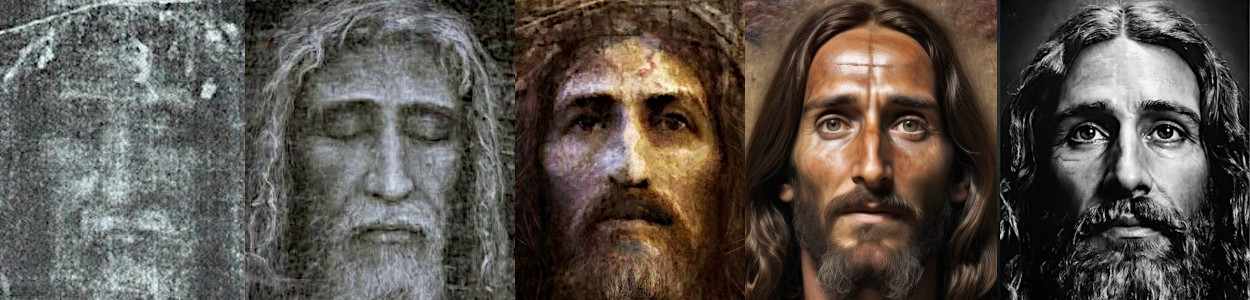
"Based on the SHROUD OF TURIN, Jesus was a physically commanding person, standing nearly 6 feet tall and weighing 175 to 180 pounds - a large man for that time in history. He had very broad shoulders and well-defined, muscular arms and legs. He had a majestic face and thick, well-groomed hair. Ethnologists have found the features of the man (long hair, beard) to be consistent with those of a Sephardic Jew living in Roman-occupied territory. His age at death is estimated to be between 30 and 45 years old."
from Clues on the Shroud of Turin Tell Us What Christ Endured on Good Friday
Holy Shroud of Turin’s Authenticity Can No Longer Be Disputed, Expert Asserts
Body image on Shroud of Turin best explained by a burst of radiation
Shroud of Turin: Believers claim ‘new evidence proves it DID cover Jesus’
Shroud of Turin: New blood analysis 'supports Biblical story about Jesus' crucifixion'

...this piece of fabric is not a hoax, pious or otherwise, but is precisely what it is purported to be - the winding-sheet of the man you call Jesus. [Yeshua] ...
The linen itself has survived this long because so many people have taken excellent care of it. Most of the time it has been kept in sealed containers where dryness helped to preserve it ...
We would think that no matter what the examination of the shroud reveals, it will have little effect on the attitudes of most religious groups,... pg. 178-179
Messages From Michael by C.Q. Yarbro
His hair was sort of wild. Other people made their hair beautiful...combed and held in place...but Jeshua never did anything to his hair...it was almost a mane. It was clean, but it was unbrushed, a kind of brown with copper [high]lights in it, and his eyes were blue and very intense.
pg.38 Power Of The Magdalene by Wilson and Prentis
Yeshua Ben Joseph
Yeshua is the Hebrew and Aramaic name for Jesus (Jesus is derived from Greek and Latin transliterations). "Jeshua" is an English transliteration that is a variant spelling of "Yeshua,"
Christ = Messiah = "anointed one"
"Christ" comes from the Greek word Christos, which means "anointed".
This is a translation of the Hebrew word Mashiach, or "Messiah"
bar enash (Aramaic) and
ben-adam (Hebrew) both
translate to [the chauvinistic]
"son of man" or
human being, humanity, mortal.
At the time of Jesus (1st-century AD Israel), the primary spoken language was Aramaic, used by common people in daily life in Galilee and Judea.
Hebrew was utilized for religious, scriptural, and academic purposes, while
Greek served as the language for trade, administration, and interaction with the Roman world.
The Roman world was multilingual, with Aramaic being the primary spoken language in Judea/Galilee, Koine ("common") Greek acting as the lingua franca across the Eastern Mediterranean for trade and administration, and Latin used for official legal and military matters.
THE ESSENES, Children of the Light
chapter 19: Being With Jesus
 Joseph of Arimathea: "After the birth, Joseph and Mary went straight to our
Brothers in Egypt, near Alexandria." (to the Essene community
near Alexandria)
Joseph of A.: I remember him as a
small boy being quite upset because he had been
reprimanded. He only needed a stern voice or just a
shift in your energy and he would notice it. We had
never seen a child like this one before, so aware, so
sensitive.
Joseph of A.: The thing that comes over most strongly is that he was much better balanced than we were. And also that he was more pure and clear and light — just very much more whole. He was exceptional because he was very quick at getting to the heart of things, but in a very quiet way. He used to sit and listen a lot, and give everyone a chance to speak, but when he came in he had it summed up very quickly. In just a few words he could bring it all together. pg.132
Daniel Benezra, friend of Joseph of Arimathea:
...he [Yeshua] just had this enormous power around him, this energy. It was a very gentle loving energy, but it was energy, and it marked him as someone very special. In some ways he was like a high priest. Even if you had known him when he was young, becoming a high priest sets him apart.
But that didn't make him heavy. There was a lot of laughter around him. Being with him was really a very joyful experience. It was sunny - being with him was just like being in the sunshine of a perfect day. But there was great power present too: it was like being with a very jovial and happy high priest. He was very light, he smiled a lot...
He was not jovial all the time, of course. Sometimes he was quite serious. But most of the time he was sunny, and being near him lightened people's lives. They were lighter as they went along the road with him, everything seemed lighter and brighter. He brought out the best in people - he brought the sunshine into people's lives...
When you were with him you felt warm and comfortable. You felt that everything was going to be all right. You felt you were going to get to the conclusion of your own spiritual path in your own time, and it would all be fine. You just had to put one foot in front of the other, smiling gently as you went.
He wasn't heavy and solemn. People around him were happy and singing - there was a lot of singing, a lot of joy. And it was very light, the whole thing.
pg.140, THE ESSENES, Children of the Light; by Wilson and Prentis
Daniel, friend of Joseph of Arimathea:
..."He [Yeshua] had clear eyes, all-seeing eyes, but much love in them and he spoke with great gentleness: great strength and great gentleness. It is said that many who had been Essenes for many years and thought they knew what it was to be an Essene, when they encountered Jesus, only then did they begin to realize what it was like to be an Essene to your fingertips."
"Jesus [Yeshua] was the ultimate Essene, the ultimate pattern of Esseneness. He was the exemplar for all of us. And when we looked at him — his power, his gentleness, the sheer radiance of this being who was nearer to God than any of us had thought possible — we could see our destiny."
- Daniel BenEzra, friend of Joseph of Arimathea
pg,134, THE ESSENES, Children of the Light; by Wilson and Prentis
Joanna: Tell us about Jesus. What was it like to be in his presence?
Nicky: It's like being transported to a different realm...it's quite remarkable... infinitely powerful and the love as well. It makes one want to get to one's knees and weep, the energy is so beautiful. It feels like going home...and it was such a relief that he was there.
We have known him right from the start, beyond time, beyond space. It goes so deep that we can only get a glimpse of the depth, the connection that we had with him,...
pg.144-145 THE ESSENES, Children of the Light; by Wilson and Prentis
 “Oh!” Harriet remarked, “We have been searching for them [the Essenes]”.
Suddi, [a Qumran Essene teacher of the law, later, one of Jesus' & John's teachers]:
"They [the Essenes] have no wish to be found. Unless they desire it, you will not find us. ... They [the Essenes] are greatly feared by those who are in power, because we have studied into the mysteries that others have only hinted at. And they fear that if we gain too much power and knowledge that they will lose their place.
There are many [Pharisees & Sadducees "in power"] who would find out about our community and see it destroyed."
D: Is there any dissension between the Essene teachers and the Jewish teachers in the area?
Suddi: Yes, they call us crazy, because we believe that the time is at hand. They have given up hope for the coming of the Messiah.
pg.30-31
[Yeshua affirms The Multiverse]:
Suddi: He[Yeshua] used ... a plant that is composed of many layers (similar to an onion). He said this would show the different planes of existence. He pointed out that, at the very center of the plant the layers are very thin and close together. If one could consider each layer as a different plane, one can see that at the centre where it’s the smallest and most limited, that is like the physical world. As one travels upward and outward in the planes, one’s horizon of understanding would expand each time and you would see and understand more.
pg.221
[Yeshua affirms/describes reincarnation (again)]:
Another example he came by from watching the water. He pointed out how a wave could come in from the sea and lap up on the shore, and pick up a bit of debris. And when this bit of debris is put back down it’s almost at the same place that it was before, but moved over slightly. And so the piece of debris will gradually travel down the shore being picked up and placed back down by the waves. He said that this is like your cycle of lives. You go through your cycle of life, starting at one point and then when you die, it’s like being picked up by the wave and then re-deposited in a [new/next] life. Your spirit is re-deposited and it’s a little bit further along the way of where you’re meaning to go.
pg.221
[Yeshua affirms The Multiverse again]:
Teaching In the synagogue:
He was wearing a light blue robe and the prayer robe, which is a long cloth ... draped about their head and shoulders like a shawl. pg.227
Suddi: In the synagogue there are a lot of times that great arguments go on. Tonight there is no arguing. The people, they are very quiet. He has a beautiful voice that is very easy to listen to... he is also trying to explain a difficult concept about the different universes, and how all our lives are interconnected. He is using the example of a tapestry to simplify what he is talking about. The tapestry, you look on the back side and it’s woven like a cloth. You look on the front side and there’s pictures and action going on. The back side where it’s woven like a cloth is like the structure of the universes. And the front side where you can see a pattern to it, that is our lives imposed upon the universes.
pg.226, Jesus And The Essenes by Dolores Cannon
Early attempts at writing gospels and letters
And then it all went wrong. It was all so dark and horrible, and we became afraid to speak. There were so many who opposed us, who wanted us to forget. And then there was this frantic writing down to try to capture what he had said.
pg.144 THE ESSENES, Children of the Light by Wilson & Prentis
Bina ... said that during the period immediately following the crucifixion, both of them [Bina & Daniel] tried to write a simple account of the life and teaching of Jeshua. However, in both cases the scrolls were found and destroyed by the Pharisees.
pg.8 Power Of The Magdalene by Wilson and Prentis
Sequentially, the Gospel of Mark was written first around 70 CE and was followed by Matthew (80 CE), Luke (85-90 CE), and then John’s gospel (95-100 CE).
However, in all cases, the earliest surviving copies have dated after 300 ad except for a few small fragments.
The KJV was primarily based on the Textus Receptus, a Greek text compiled by Erasmus (1516), which used manuscripts dating from the 10th to 12th centuries, not the earliest, but representative of the Byzantine (Eastern Roman) tradition.
Josephus
Antiquities of the Jews is a 20-volume historiographical work, written in Greek, by the Roman-Jewish historian Josephus in 94 CE/AD Josephus wrote a paragraph about Jesus ... but it has been heavily revised by Christian scribes, and Josephus's original remarks cannot be discerned.A Russian translation of Josephus' historical writings is different. Jesus, in this version, is described as human, as a political revolutionary, and as "a king who did not reign." He is also said to have had "a line in the middle of his head in the manner of the Nazarenes."
Holy Blood, Holy Grail by Baigent, Leigh, & Lincoln pg. 377
 [Also] for the epistles [letters] the problem of false names and forgery was acute.
Already, in the Second Epistle to the Thessalonians, Paul had to warn his
audience against the possibility of fake letters with which some Christians
were trying to mislead their fellow Christians ... pg.130
[Again] In 170 A.D. and again in 250 A.D.:
In the 170's we have the instructive protest of Dionyisus, Bishop of Corinth: Christians were changing and faking his own letters, he said, just as (he knew) they had changed the Gospels.
The letters of Cyprian, Bishop of Carthage (c. 250 ad), reveal that Christian contemporaries had been faking letters in Cyprian's name quite freely and sending them to other churches in order to discredit him.
pg.130, The Unauthorized Version by Robin Lane Fox
 [Again] "In A.D. 303 ...the pagan emperor Diocletian had destroyed all
Christian writing that could be found. As a result Christian documents -
especially throughout the Roman Empire - all but vanished. When
Constantine commissioned new versions of these documents, it enabled
the custodians of orthodoxy to revise, edit, and rewrite their material
as they saw fit, in accordance with their tenets.
... [today] Of the five thousand extant early manuscript versions
of the New Testament, not one predates the fourth century." [the 300's]
pg.368 (except a few bits and pieces)
- Holy Blood, Holy Grail by Baigent, Leigh, & Lincoln
Not Nazareth but Nazarene
"Changeing terms with ideological connotations into geographical place names tends to trivialize them. This is certainly the case with confusions relating to whether Jesus came from a place in Galilee called Nazareth (never mentioned in either the works of Josephus or the Old Testament) or whether, like James, he followed a 'Nazirite' life style or was a 'Nazarene' or 'Nazoraean', which have totally different connotations..."pg.XXVII James the Brother of Jesus by Robert Eisenman
 Essenism, Zealotism, Messianic Saduceeism, Nazoraeanism - or perhaps even
"Naziritism" (the wordplay is probably deliberate) and a kind of "Essene"
Zealotism. As we shall show, these are all simply variations on a theme well
developed at Qumran.
pg.xiv The Dead Sea Scrolls and The First Christians by Robert Eisenman
The Gospels' silence about Zealots ... must surely be indicative of a relationship between Jesus and these patriots which the Evangelists preferred not to disclose. JESUS AND THE ZEALOTS by Brandon pg. 327
The Essenes were "zealous for the law". Simon the Zealot was a disciple of Jesus. Judas was also possibly a Zealot.
It was common knowledge that Zealots [and Essenes?] would have nothing to do with Roman money: "Roman currency, particularly the silver denarius, often bore the image of the Emperor and inscriptions calling him divine (e.g., "son of god" or "high priest"). The Zealots considered holding or using such coins to be blasphemous and a violation of the prohibition against graven images.
Jesus takes the Zealot [and Essene?] position, refusing to carry or touch a Roman coin. He does NOT have one. He is shown one. He does not touch it.
Matt 22:17-22 [The Pharisees asked] “Is it right to pay the imperial tax to Caesar or not?” But Jesus, knowing their evil intent, said, ...“Show me the coin used for paying the tax.” They showed him a denarius, and he asked them, “Whose image is this? And whose inscription?” “Caesar’s,” they replied. Then he said to them, “So give back to Caesar what is Caesar’s, and to God what is God’s.”
[Jesus did not carry a Roman coin and did not touch one. ... To the crowd, he was one with the Zealots. (cheering in the background!)]
Romans mandated their own imperial currency for direct taxes, but local and regional foreign silver coins - most notably the Tyrian shekel - were plentiful . . . The money-changers referenced in the New Testament Gospels [Mark 11:15-17 etc.] provided Tyrian shekels in exchange for Roman currency. ... The Roman authorities allowed the Jewish rabbanim to mint Tyrian shekels in Judaea.
Zealot or not, Jesus was certainly charged, prosecuted and sentenced as one.
Jesus The Jew by Vermes pg. 50
By Josephus account of the fall of Masada in 74 A.D., the rebel Zealot leader was a man named Eleazar (a variant on the name of Lazarus) and he and all his people were Zealots according to history, but Eleazar's last speech, as reported by the only survivors, was "unmistakeably Essene, Gnostic, and dualist"
- Holy Blood, Holy Grail by Baigent, Leigh, & Lincoln pg. 376
on Luke: ...there is no record or apparent possibility of a universal Roman census ever in the empire until Vespasian and Titus conducted a Roman census in 74 CE. Luke erroneously [inserted] features from his contemporary paradigm onto his nativity narrative. Whoops! So, the takeaway from Luke’s historical gaffe is that we can be assured that the Gospel of Luke was composed after 74 CE, and probably appreciably so.
https://bibleoutsidethebox.blog/2017/07/24/ when-were-the-gospels-written-and-how-can-we-know/
"Roman censuses cared nothing for remote genealogies,let alone for false ones: they were based on ownership of property by the living, not the dead." ... "Luke's story is historically impossible and internally incoherent"
pg.31, The Unauthorized Version by Robin Lane Fox
Mark's Gospel finishes at 16:8
Most Bibles have a footnote at Mark 16:8 stating that the verses beyond 16:8 are from unknown authors [around 300 AD (325?)]
ex: "The earliest manuscripts and some other ancient witnesses do not have verses 9–20." NIV
see https://www.BiblicalArchaeology.org/daily/biblical-topics/new-testament/the-strange-ending-of-the-gospel-of-mark-and-why-it-makes-all-the-difference/
Beyond Mark 16:8, the extended ending does not even sound like Mark. and the chauvinist slandering of Mary Magdalene in this extension calls into further question the only other chauvinist slandering of Mary, and other women, in Luke 8:2-3 where the only value of (scorned, formerly afflicted) women is in the money they can provide to the men]:
Luke 8:2-3 NIV
The Twelve were with him, and also some women who had been cured of evil spirits and diseases: Mary (Magdalene) from whom seven demons had come out; Joanna the wife of Chuza, the manager of Herod’s household; Susanna; and many others. These women were helping to support them out of their own means.
The motivation behind the discrediting: Biblical scholars suggest that some early church leaders downplayed Mary Magdalene's influence because her prominence was uncomfortable for the men who led the early church. Mary Magdalene was a notable figure in Jesus' ministry. Most significantly, she was the first person to witness Jesus' resurrection and was sent by him to tell the other disciples—earning her the traditional title "Apostle to the Apostles" (John 20:11–18)
also:
John 8:1-11 ... a famous addition [stoning an adulterous woman] which is not the author's [not John's]
pg. 142-143, The Unauthorized Version by Robin Lane Fox
"John 21 ... that [last] chapter, which scholars judge to be a later [false] addition to John's gospel"
pg.186 Jesus A Revolutionary Biography by John Dominic Crossan
In 2016, Pope Francis elevated the liturgical celebration of Mary Magdalene to a feast day, acknowledging her as an important apostle
Emphasis on her actual role: With the older tradition debunked, there is now a greater emphasis on Mary Magdalene's true role as a devoted follower who witnessed Jesus' death and was the first person to see the risen Christ. This is reflected in Pope Francis's 2016 elevation of her memorial to a feast day, recognizing her as the "Apostle of the Apostles" for her role in the early church
 There were three who always walked with the Lord: Mary his mother
and his sister and Magdalene, the one who was called his companion.
His sister and his mother and his companion were each a Mary.
PG.59:6-10
from The Nag Hammadi Library : The Gospel of PHILIP
And the companion of the Savior is Mary Magdalene. But Christ loved her more than all the disciples and used to kiss her often on her mouth. (The rest of the disciples were offended by it and expressed disapproval.) PG.63-64:31-38
from The Nag Hammadi Library : The Gospel of PHILIP
January 6th the earliest tradition of Jesus birth, in 5 BC [best guess] (Herod died in 1 or 4 B.C.) ... whereupon he returned from Egypt - aged about 3 or 4, after Herod's death.
April 3, AD 33: The Exact Date Jesus Died - set by the 3 hour blackout.
Virtually all scholars believe, for various reasons, that Jesus was crucified in the spring of AD 33, ... when a world-wide 3 hour blackout occurred, and April 3rd was "good friday" that year.
Thallus, a Samaritan historian of the 1st century, said in the third book of his Histories, quoted by Julius Africanus 176 (c. 220 CE): A most terrible darkness fell over all the world, the rocks were torn apart by an earthquake, and many places both in Judea and the rest of the world were thrown down. Phlegon of Tralles gives a specific date, reported by Eusebius: In the 4th year of Olympiad 202, an eclipse of the sun happened, [but NOT by the moon] greater and more excellent than any that had happened before it; at the 6th hour, day turned into dark night ... and an earthquake in Bithynia toppled many buildings of the city of Nicaea. The 4th year of the 202nd Olympiad is from July 32 to June 33 CE, which confirms the date of April 3rd, 33 CE. This information was considered reliable at the time because Origen (early church father, 185 - 254 A.D.) (in 248 CE) quoted it to refute Celsus (Against Celsus II:14,33,59), a Greek philosopher very critical of Christianity but familiar with history.
see https://time.graphics/period/2710214
According to Luke 3:23, Jesus was “about 30 years old” when he began his ministry. If Jesus was born in 5 B.C. and began his ministry, as is indicated by all four Gospels, shortly after that of John the Baptist (that is, in the latter part of the year A.D. 29), this would mean that Jesus was about 33 years old when he began his public ministry - which lasted about 3 1/2 years. (to April 33 AD)
John’s Gospel records Jesus’ appearance at at least 3 Passovers:
in Jerusalem (2:13, 23);
in Galilee (6:4); and
again in Jerusalem (11:55; 12:1).
Matthew 17:27
"it is the only miracle in Matthew that is predicted, but not explicitly performed.... [Matthew] structures the story so that it ends ... Like a well told joke," [which it was: "a comon joke"] https://aspiringapollos.com/home/2023/11/5/ matthew-subjects-and-sons-1724-27
"A popular joke from Matthew 17:27 is about a fisherman who uses his 'fin-ancial' skills to pay taxes with a fish, humorously playing on the biblical story of Jesus telling Peter to find a coin in a fish's mouth to pay the temple tax."
"A popular joke from Matthew 17:27 is about Jesus telling Peter to 'go fishing for taxes,' where he'd catch a fish with a coin in its mouth to pay the temple tax for both of them. "The humor comes from the absurdly specific and miraculous instructions: Peter, a professional fisherman, is told to use a single hook to catch the first fish, which will contain a specific coin in its mouth to avoid an argument with tax collectors" google search: Matthew 17:27 joke about paying taxes with a fish
Nothing in Exodus says that the tax was to be paid annually. Yearly payment became the tradition over time. As far as the law itself was concerned, it was imposed only one time - when a man became twenty years of age - and beyond that it was voluntary. Even more, rabbis (Jesus) were exempt, as were the priests who served in Jerusalem. The Sadducees generally disapproved of the tax, and the men of the Qumran community paid it only once in their lifetimes. "remember to keep ourselves in on the joke" https://faithpca.com/what-jesus-really-said-messiah-fish-and-taxes/
 "It was when Christianity spread out into the Pagan world that
the idea of Jesus as a Savior God emerged. ... It was the birthday
of Mithras, the 25th of December (the winter solstice) that was
taken over by the Christians to be the birthday of Jesus.
Even the Sabbath, the Jewish seventh day appointed by God in
the Mosaic Law and hallowed by his own resting on this day after
the work of Creation, had to be abandoned in favor of the
Mithraic first day, the Day of the Conquering Sun."
- The Meaning Of The Dead Sea Scrolls by A. Powell Davies; pg.90
By an edict promulgated in A.D. 321, for example, Constantine ordered the law courts closed on "the venerable day of the sun" and decreed that this day be a day of rest. Christianity had hitherto held the Jewish Sabbath - Saturday as sacred. Now, in accordance with Constantine's edict, it transferred it's sacred day to Sunday. ... "Until the fourth century, moreover, Jesus birthday had been celebrated on January 6th."
- Holy Blood, Holy Grail by Baigent, Leigh, & Lincoln page 367
"early Christians adopted solar imagery and traditions, like depicting Christ with solar halos, reflecting Sol's attributes as "Unconquered Sun" and divine light to make Christianity more appealing" "Early Christian art, such as a 3rd-century mosaic in the Tomb of the Julii (under St. Peter's Basilica), shows Christ depicted as Helios (the Greek sun god) driving a solar chariot, with solar rays emanating from his head, much like Sol Invictus."
In the interests of unity Constantine deliberately chose to blur the distinctions among Christianity, Mithranism, and Sol Invictus - deliberately chose not to see any contradictions among them. Thus, he tolerated the deified Jesus as the earthly manifestation of Sol Invictus.
- Holy Blood, Holy Grail by Baigent, Leigh, & Lincoln page 367
Emily said, "what is the meaning in the Scriptures that Christ died
to save our sins? It makes no sense to me.”
It does not make sense to us, either. ...it is meaningless. He did not say that. That was perpetuated by zealots. pg. 175
"Then can you explain the Sermon on the Mount? I do not understand it. Substitute for the word “blessed” the word “fortunate.” The emphasis here is on simplicity. By “meek,” we do not speak of cowardice, but rather of an inwardness of purpose." pg. 175
“Is it true that Christ was able to cast out demons?”
The demons are produced by the sick mind and do not exist. They can be cast out only by one skilled in this. The exorcist must be able to give the patient a visible substitute; thus he must be capable of producing psychic phenomena at will. Jesus was an occult master. He could produce the necessary phenomena to make the patient see his demon leave and occupy some other organism. Then, of course, you must still treat the sickness which caused the soul to produce the demon. Usually this is masochism in its extreme manifestation. pg. 177
"Was he really conceived without sex? of course not." pg. 177
[Jesus referred to himself as a son of man so often that it is in the New Testament over 80 times.
Jesus was Yesuah Ben Joseph]
“I’ve read much on the crucifixion and have never been able to figure out why it happened.”
"He was a threat to Joseph Caiphas, who was getting rich on the temple funds and there was a suitable pawn available in the person of the Judean governor [Pontius Pilate], who was a coward and who already was in trouble with Tiberius over other things." pg. 177
"For those who wonder about the height and size, this was a robust and healthy man, not exactly the wispy ascetic type." pg. 178
Today's Christianity bears little resemblance to the teachings of the man Jesus [Yeshua] ... We would also like to remind you that much of the chronology of the events in this man's life is confused, distorted, and in some instances, wholly fictionalized. pg. 183
Messages From Michael by C.Q. Yarbro
"When Matthew quotes Isaiah 7:14 in Matthew 1:23, he quotes the Greek version of this verse" ...which falsifies the original “almah”, "young woman", to "virgin": "the Hebrew word alma refers to a young woman, a maid, or a newly married woman."
Isaiah 7:14
“Behold, a newly married woman will be with child and bear a son, and she will call His name Immanuel”
"a young woman without reference to her virginity."
https://aish.com/does-isaiah-714-refer-to-a-virgin-birth/
 Mark 11:12–14,20–25; Matt. 21:18–22;
...the story of the fig tree. ...it had always seemed out of character for Jesus to damn a tree because the figs were out of season, I asked the guides about it. This is their reply:
“The fig tree incident is purely symbolic, for Jesus knew when fruit is due and when it is not. By the telling of that parable he was demonstrating that any good we do bears good fruit, whereas those thoughts and actions which are evil will shrivel the tree (our souls) and cause barrenness in our spiritual growth. You know that the stories in the New Testament were passed on by word of mouth for a long time before they were written in the form we know them. Someone manufactured the tale that the tree to which Jesus pointed then withered and died, for Jesus was using it only as a dramatic example, and he attempted nothing beyond that. page 84
Furthermore, the 2 accounts contradict each other: "Matthew 21 shows Jesus curse the fig tree after he clears the temple courts and the disciples see it wither immediately. This contradicts Mark 11 which states that Jesus cursed the fig tree, clears the temple courts and the disciples only see and comment on how quickly it withered the next morning."
The Essenes ... and also the Biblical Pharisees believed in reincarnation, as did the followers of Jesus and the early Christians. pg.15-16The Jewish Talmud states that the soul of Abel passed into the body of Seth and subsequently into that of Moses. pg.17-18
I asked the Guides whether Jesus liked animals, and whether there were any incidents to demonstrate it. They replied: “As to animals, Jesus adored the fleecy, flat-tailed lambs that made excellent pets before they reached maturity, and he often used them in his teachings as examples of gentleness and tenderness. He yearned after all forms of life as gifts from the Creator and walked fearlessly among all animals, even wild ones, as if they were his brothers. Often did he stoop to pet dogs and cats, a gesture so normal with him that none thought to add it to their accounts that were passed along to those who later wrote the Gospels.” pg.113
Companions Along The Way by Ruth Montgomery
"During the week I had reviewed my textbook from a comparative religions course taken during my freshman year at Columbia Univ. There were indeed references to reincarnation in the Old and New Testaments. In A.D. 325 the Roman emperor Constantine the Great, along with his mother, Helena, had deleted references to reincarnation contained in the New Testament. The Second Council of Constantinople, meeting in A.D. 553, confirmed this action and declared the concept of reincarnation a heresy." pg.35-36
- Many Lives, Many Masters by Brian L. Weiss, M.D.
"It is a common supposition that we have in the New Testament a
self-consistent story of the life of Jesus, followed by a plain
account of the beginnings of the church... These assumptions
are not true. We do not have the story of Jesus; we have only
a fragmentary record. It is not self-consistent; it is contradictory.
The account of the beginnings of the church is not simple;
it is full of problems."
- The Meaning Of The Dead Sea Scrolls, by A. Powell Davies; pg.85
"Finally Christ is sent down to save humanity by reminding people of their heavenly origin. Only those who possess this knowledge and have lived ascetic lives can return to the realm of light; the others are reincarnated until they also come to saving knowledge.
- the introduction to The Apocrypha of JOHN, (before 185 A.D.)
- The Nag Hammadi Library
"Know that if you become worse you will go to the worse souls, and if better, to the better souls; and in every succession of life and death you will and suffer what like must fitly suffer at the hands of like"
The Republic, Plato (582 - 507 B.C.)
"We were in being long before the foundation of the world; we existed in the eye of God, for it is our destiny to live in Him. We are reasonable creatures of the Divine Word; therefore, we have existed from the beginning, for in the beginning was the word."
- St. Clement of Alexandria - (150 - 220 A.D.)
"Every soul... comes into this world strengthened by the victories or weakened by the defeats of it previous life. Its place in this world as a vessel appointed to honor or dishonor, is determined by its previous merits or demerits. Its work in this world determines its place in the world which is to follow this."
- De Principiis by Origen (early church father) (185 - 254 A.D.)
“the most distinguished and most influential of all the theologians of the ancient church, with the possible exception of Augustine,”
- Encyclopaedia Britannica
"...it is absolutely necessary that the soul should be healed and purified, and if this does not take place during its life on earth, it must be accomplished in future lives."
- St. Gregory - (257 - 332 A.D.)
St. Augustine: 354 - 430 A.D.
"Did I not live in another body, or somewhere else, before entering my mother’s womb?”
In 'Contra Academicos' Augustine further declares: “The message of Plato, that Plato is born again in Plotinus.”
Also: The Encyclopaedia Britannica states that “the soul,” according to Plato, “is immortal, the number of souls fixed, and reincarnation regularly occurs.”
"...in a position summarized by Rudolf Bultmann of the University of Marburg, one of the most important, most famous and most esteemed of twentieth-century biblical commentators:"
"I do indeed think that we can now know almost nothing
concerning the life and personality of Jesus, since the
early Christian sources show no interest in either [and]
are moreover fragmentary and often legendary."
- Jesus And The Word by Rudolph Bultmann pg.8
- Jesus And The Word by Rudolph Bultmann pg.8
"Yet Bultmann remained a devout Christian. He did so by insisting on a crucial distinction between the Jesus of history and the Christ of faith."
- The Messianic Legacy by Baigent, Leigh, & Lincoln pg.2
"There is still the teaching of the 'Kingdom of heaven within you' ... 'The sabbath is made for man and not man for the sabbath.' ... 'Return good for evil; love your enemies.' ... Religion can be summed up, said Jesus, in two principles; 'Love God sincerely and other people as much as you love yourself.' (( Mark 12:30-31; Matt 22:37-39; Luke 10:27 )) Jesus said: 'Do unto others as you wish them to do unto you.' He did not invent these summaries of 'the Law and the Prophets,' but he makes his emphasis clear by the fact of selecting them."
- The Meaning Of The Dead Sea Scrolls by A. Powell Davies pg.128
Luke 17:20-21. Some Pharisees asked Jesus when the kingdom of God would come. His answer was, "The kingdom of God does not come in such a way as to be seen. No one will say, `Look here it is!' or, `There it is!'; because the kingdom of God is within you."
"One of the most problematic phrases in the Bible is "the kingdom of God". The Aramaic and Hebrew words of Jesus did not imply a territory or domain. Instead, they referred to a power that is coming to be. pg. 61
"For centuries, Jewish prophets compared the realm of God to the famed cedars of Lebanon, which were used to build the temple of Solomon in Jerusalem. So Jesus shocks his audience by likening it to a tiny mustard seed, which grew into a scraggly plant that most farmers considered a weed. pg. 95
- THE LOST GOSPEL Q, the original saying of Jesus
- Marcus Borg, consulting editor
Matthew 19:17
Why do you ask me concerning what is good? There is only One who is good.
Mark 10:17-18 and Luke 18:17-18
Good teacher, what must I do to receive eternal life? Why do you call me good? No one is good except God alone.
Jesus would not even let a person call him "good"!! Yet, the New Testament makes a god out of him! How much more would that upset him!?!
Jesus would not even let a person call him "good" in Matthew, Mark and Luke. So how do we explain the 4th gospel, John, claiming Jesus is the same as God and that we are all Gods...
"It is written in your own Law that God said, 'You are all gods.' We know that what the scripture says is true forever; and God called those people gods" John 10:34-35
So even John declares that Jesus is not someone that the rest of us are not. He can claim that Jesus was "one with God" because we all are. We are all Gods and "the kingdom of God is within", Luke 17:21.
"And when she saw the infant Jesus she exclaimed, behold Immanuel! Behold the signet cross of the Messiah on his brow! And then the woman knelt to worship him, as God with us, Immanuel; but one, a master, clothed in white, appeared and said, Good woman, stay; take heed to what you do; you may not worship man; this is idolatry. This child is man, the son of man, and worthy of all praise. [but] You shall adore and worship God; him only shall you serve.
The Aquarian Gospel Of Jesus The Christ 4:10-12 by Levi
In the year 325, in Nicea, the church was holding a council "the Council of Nicea" that declared that Christ was "the Savior God" and wrote a creed "the Nicean Creed" to enforce it, and today, we are not told how it all happened. Time after time Jesus refers to himself as a "son of man" (Mark 8:31,38; 9:9,12,31, etc.) (as if he knew people would try to make a god out of him?); but the expected Messiah(s) of the Hebrew people was a great prophet, NOT a god, and Jesus himself seems to oppose it: "No one is good except God alone" and "you are all gods".
"there were many Pagan deities during the time of Jesus and
afterwards for whom quite similar claims were made and in whose names
were preached quite similar doctrines. Mithras was a Redeemer of
mankind; so were Tammuz, Adonis and Osiris. The view eventually
taken of Jesus as a Redeemer was not a Judaic concept; nor was it
held by the first Christians in Palestine. The Messiah the Jews
and the Judaic Christians expected was not the Son of God but a
messenger from God, not one who saved by blood-atonement but one
whose salvation came from his rule of the earth in a Messianic
kingdom. pg.90
The Meaning Of The Dead Sea Scrolls by A. Powell Davies
"Faith, in short, was for Constantine a political matter; and any faith that was conductive to unity was treated with forbearance. . . . In A.D. 325, for example, he convened the Council of Nicea. At this council, the dating of Easter was established. Rules were framed that defined the authority of bishops, thereby paving the way for a concentration of power in ecclesiastical hands. Most important of all, the Council of Nicea decided, by vote, that Jesus was a god, not a mortal prophet. Again, however, it must be emphasized that Constantine's paramount consideration was not piety but unity and expediency. As a god, Jesus could be associated conveniently with Sol Invictus. As a mortal prophet he would have been more difficult to accommodate. In short, Christian orthodoxy lent itself to a politically desirable fusion with the official state religion; and insofar as it did so Constantine conferred his support upon Christian orthodoxy.
Thus, a year after the council of Nicea he sanctioned the confistication and destruction of all works that challenged orthodox teachings ...
In A.D. 303, a quarter of a century earlier, the pagan emperor Diocletian had undertaken to destroy all Christian writings that could be found. As a result, Christian documents - especially those in Rome - all but vanished. When Constantine commissioned new versions of these documents (in 331), it enabled the custodians of orthodoxy to revise, edit, and rewrite their material as they saw fit, in accordance with their tenets. ... [today] Of the five thousand extant early manuscript versions of the New Testament, not one predates the fourth century. pg.368
HOLY BLOOD, HOLY GRAIL by Baigent, Leigh, & Lincoln
JESUS QUOTED SCRIPTURE THAT SAID "IT IS KINDNESS I WANT, NOT ANIMAL SACRIFICES"
(Matt. 9:13 & 12:7 also see Mark 12:32-34).
Matt.9:13; & 12:7
I desire mercy, and not sacrifice,
Jesus did not want sacrifices, and so if asked, he would certainly have said "No!"
It is contradictory to say that Jesus wanted kindness, not sacrifices, and then claim that he was the ultimate of all sacrifices. It is the ultimate insult. It must be very frustrating to have so much that you say ignored, and so much of the rest distorted or even deleted.
"And when she saw the infant Jesus she exclaimed, behold Immanuel ! Behold the signet cross of the Messiah on his brow!
The Aquarian Gospel Of Jesus The Christ 4:9 by Levi
When I first read of this woman's discovery concerning the forehead of the baby Jesus, it meant nothing to me till I read of the practice of the Essenes at Qumran:
"The Qumran...members...marked the foreheads of their initiates with the sign given in Ezekiel 9 for marking the truly enlightened - those who grieved over the abominations practiced in Jerusalem (Later Christian use of the X was believed to be the first initial of the Greek work Christos, but the actual practice of making the initiated "elect" was the same) pg.56
The Woman With The Alabaster Jar by Margaret Starbird
Paul: ". . . I did not consult any man, nor did I go up to Jerusalem to see those who were apostles before I was, but I went immediately into Arabia and later returned to Damascus. Then after three years, I went up to Jerusalem to get acquainted with Peter and stayed with him fifteen days. I saw none of the other apostles-only James, the Lord's brother"
(Gal. 1:16-19).
In one story, Matthew has Jesus saying "What little faith you have! Don't you understand yet? Don't you remember...? How many...? What about...? How many...? How is it that you do not understand ...?"
(Matt 16:9-11)
In Mark's account, he has Jesus saying "Don't you know or understand yet? Are your minds so dull? You have eyes - can't you see? You have ears - can't you hear? Don't you remember ... ? How many...? ...how many ...? ... And you still don't understand?" (Mark 8:17-21).
Once, when Jesus spoke of his coming death, Matthew relates that "The disciples became very sad." (17:23) Mark says "They did not understand what this teaching meant and they were afraid to ask him." (9:32)
When Jesus blesses the children (Matthew 19:13, Mark 10:13, and Luke 18:15), it is Mark who says that Jesus was angry at his disciples for trying to keep the children away.
All the gospels say Jesus had to explain to the disciples, in private, the meanings of his parables. Perhaps Mark felt most frustrated by their lack of understanding. In any case, there is no way they could always remember exactly what he said when they had such a hard time understanding what he meant. And, if THEY had trouble, 50 to 200 years later, the problems for those who try to put the events and statements into writing are magnified further.
At the time of Jesus, the Hebrew man or woman who did not have children would be considered a very disobedient Jew, but for a priest it would be a scandal and hypocrisy. There were even laws on the subject: "An unmarried man may not be a teacher".
HOLY BLOOD, HOLY GRAIL by Baigent, Leigh, & Lincoln pg. 330-337
"The three wise men were
CASPAR, MELCHIOR,and BALTHASAR"
"Mary's [Mary Magdalene's] grandfather was Balthazar, one of the Three Wise Men, and he came from Persia. Her father, a wealthy merchant called James, had met Joseph of Arimathea on his travels and became his friend, and when James died while Mary was still a child, Joseph adopted her and brought her to Israel. Mary was eight years old when her father died, and she went to live in Joseph of Arimathea’s large and comfortable home in Jerusalem. A frequent visitor to that house was Joseph’s nephew Jeshua (Jesus) then eleven years old." ["Joseph of Arimathea was the older brother of Mary the mother of Jesus ...he was about 4 years older"]. "Mary Magdalene and Jeshua developed an intense friendship and became aware of a powerful spiritual bond that extended over many lifetimes. They had one magical year together before Jeshua went off at the age of twelve on his longer journeys"
book: The Magdalene Version, by Wilson & Prentis; page 69
and
book: The Essenes, Children Of The Light, by Wilson & Prentis; page 131

ip: 216.73.216.201